
8 DFS Lessons We Learned From NFL Week 2
Week 2 gave us a much better picture of what matters in DFS than Week 1 did.
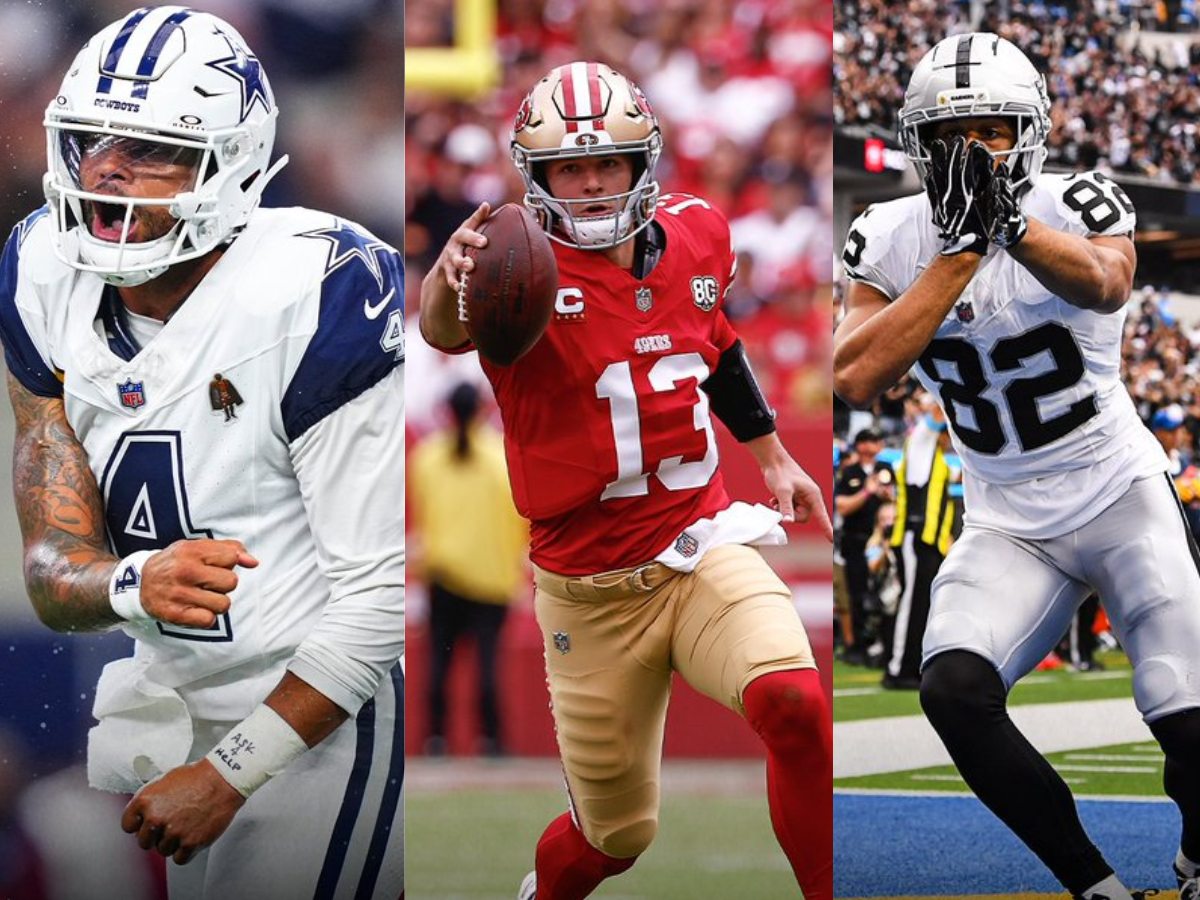
Early in the season, it’s easy to lean too heavily on last year’s rankings, preseason expectations, or one isolated matchup advantage. But after two weeks of actual football, we’re starting to see which trends are real — and which assumptions need to be thrown out.
Some of our strongest Week 2 reads hit in a big way. Dak Prescott and CeeDee Lamb exploded in the game environment we targeted. Christian McCaffrey delivered despite poor rushing efficiency. Dalton Schultz became exactly the kind of injury-created value we wanted. San Francisco’s offense smashed Miami.
We also had misses, particularly at defense, that exposed flaws in the way we were evaluating certain spots.
Here are the eight biggest lessons we’re carrying forward.
1. Start With Game Environments, Not Individual Players
Washington-Dallas was the clearest example.
We identified it as one of the strongest potential shootouts on the slate and built around that assumption.
The result:
- Dak Prescott: 279 yards, 4 TDs
- CeeDee Lamb: 8 catches, 153 yards, 2 TDs
- Stefon Diggs: 5 catches, 47 yards, 2 TDs
- Jake Ferguson: 4 catches, 43 yards, 2 TDs
Dallas scored 37 points and Washington added 20.
The lesson isn’t simply that Dak and CeeDee were good plays.
The more important takeaway is that once we correctly identified the offensive environment, several players within that game had tournament-winning paths.
Rather than trying to perfectly predict every individual matchup, we should first identify the one or two games most likely to produce concentrated fantasy scoring.
Then build stacks around them.
Going forward: Game environment comes first. Player selection comes second.
2. Touchdown Environment Matters More Than Rushing Efficiency
Christian McCaffrey is the perfect example.
Against Miami, CMC rushed 10 times for only 23 yards.
If we were evaluating him purely by rushing efficiency, the play looked terrible.
He still scored two touchdowns.
San Francisco scored 35 points and repeatedly reached the red zone. McCaffrey remained the player most likely to receive high-value touches once the offense got there.
That’s what matters.
For premium running backs, we need to place more emphasis on:
- Goal-line ownership
- Receiving involvement
- Team scoring expectation
- Likelihood of playing with a lead
- Overall offensive efficiency
A running back averaging 5.0 yards per carry on a bad offense can easily lose to a back averaging 2.5 yards per carry who gets three cracks from inside the five-yard line.
Going forward: Chase high-value touches, not just projected rushing yards.
3. Injury-Created Target Vacuums Are Gold
Dalton Schultz was one of our best Week 2 calls.
Nico Collins was ruled out, leaving a huge number of targets available in Houston’s offense.
Instead of simply upgrading every remaining Texans wide receiver, we focused on where those targets were most likely to go structurally.
Schultz had already received eight targets in Week 1.
With Collins unavailable, he exploded for:
12 catches, 140 yards
That is exactly the type of salary-adjusted opportunity we want to identify.
When a high-volume player is removed from an offense, the key question shouldn’t be:
“Who is the backup?”
It should be:
“Where does this quarterback naturally redistribute those throws?”
Sometimes that means another WR.
Sometimes it means a slot receiver.
Sometimes it means a running back.
And sometimes, as with Schultz, the tight end becomes the primary beneficiary.
Going forward: Treat injuries as target-distribution puzzles, not simple depth-chart promotions.
4. Weather Matters — But Only When It Reinforces the Matchup
We downgraded the Minnesota-Chicago passing game Sunday morning because of significant wind and rain.
That game finished:
Minnesota 9, Chicago 3
Neither offense reached 300 yards.
Caleb Williams threw for only 138 yards.
Carson Wentz threw for 143.
The weather mattered, but it wasn’t the only reason to downgrade the game.
Minnesota also brought one of the NFL’s most aggressive pressure schemes. Brian Flores had blitzed Jordan Love relentlessly the previous week and continued applying pressure against Chicago.
That combination was the important part:
Bad weather + difficult defensive scheme + pressure risk
Weather shouldn’t automatically eliminate good offenses from DFS consideration.
But when poor conditions reinforce an already difficult matchup, we need to take them seriously.
Going forward: Don’t react to weather in isolation. React when weather amplifies an existing football problem.
5. A Great RB Matchup Can Be Destroyed By a Bad Quarterback
This was our Bijan Robinson lesson.
Everything about the matchup looked right.
Carolina had been destroyed on the ground in Week 1. Bijan remained the centerpiece of Atlanta’s offense. Silva’s matchup analysis supported the play.
And Bijan himself wasn’t terrible:
16 carries, 72 yards
But Atlanta scored only three points.
Why?
The quarterback play completely destroyed the offense.
Cooper Rush and Jack Strand combined for three interceptions, while Atlanta committed five total turnovers.
Bijan never got the offensive environment necessary to produce a ceiling game.
This is an important distinction.
A weak opposing run defense does not automatically create a great RB play.
The running back’s offense still needs to function well enough to sustain drives and reach scoring position.
Going forward: Offensive competence is a prerequisite for premium running-back ceiling.
6. “Backup Quarterback” Is Not Enough Reason to Play a Defense
This was our biggest miss.
We liked Arizona’s defense largely because Drew Lock was starting for Seattle.
Lock responded with:
235 yards, 3 TDs, 0 INT
Jaxon Smith-Njigba destroyed Arizona for:
9 catches, 155 yards, 3 TDs
Seattle won 31-7.
The mistake was treating the quarterback downgrade as the primary variable.
There were still competent pieces around Lock. Seattle had a strong offensive system, an elite No. 1 receiver, and enough protection to allow him to function.
Compare that with Pittsburgh.
Aaron Rodgers was playing behind an offense already showing serious structural problems. New England generated pressure, forced turnovers and scored a defensive touchdown in a 20-3 win.
That leads us to a better DST formula:
Bad offensive line + pressure-sensitive quarterback + dysfunctional offense + capable opposing pass rush
That is far more predictive than simply targeting a backup quarterback.
Going forward: Attack dysfunctional offenses, not quarterback names.
7. TE Strategy Should Change Based on Contest Type
Dalton Schultz was clearly the superior volume play at tight end.
But Jake Ferguson reminded us why touchdown equity still matters in tournaments.
Ferguson’s role looked questionable entering the week. His Week 1 usage wasn’t impressive, and there were legitimate concerns that Dallas was spreading TE snaps around.
Then Dallas scored 37 points.
Ferguson caught:
4 passes, 43 yards, 2 TDs
Was Schultz the better projection?
Absolutely.
Was Ferguson still capable of being part of a winning tournament lineup?
Absolutely.
That distinction matters.
For safer builds and single-entry lineups, we should prioritize:
- Targets
- Routes
- Playing time
- Salary efficiency
For large-field tournaments, we should remain willing to use lower-volume tight ends who have strong touchdown correlation with quarterbacks in high-scoring offenses.
Going forward: Volume drives floor. Offensive TD equity drives tournament ceiling.
8. 2026 Evidence Now Matters More Than 2025 Reputation
Two games isn’t a massive sample.
But it’s enough to stop blindly treating last season’s strengths and weaknesses as current truth.
Several teams are already forcing reevaluation.
Cincinnati’s defense may be legitimately improved
Houston ran 78 plays and gained 374 yards, but scored only six points.
Cincinnati generated consistent pressure and has now shown signs in consecutive games that its offseason defensive overhaul mattered.
The Bengals should no longer automatically be treated like last year’s defense.
Pittsburgh’s offense is becoming a defense to target
The Steelers produced just:
235 yards and 3 points
Aaron Rodgers threw for 187 yards with no touchdowns, an interception and multiple sacks.
That offense now has two straight concerning performances.
The Chargers offense is struggling
Los Angeles has scored 14 points in each of its first two games.
Justin Herbert threw two interceptions against Las Vegas, and the offense again failed to generate consistent explosive production.
We need to stop pricing the Chargers based on theoretical offensive talent alone.
Miami remains exploitable
San Francisco averaged 7.8 yards per play and scored 35 points against the Dolphins.
Miami continues to look like a defense worth attacking.
Seattle’s defense looks legitimate
Arizona finished with only:
151 total yards and 3.2 yards per play
Seattle has now given us more evidence that its defense should be treated seriously.
Las Vegas may be better offensively than expected
Kirk Cousins has thrown three touchdown passes in consecutive games, and the Raiders have shown an ability to generate explosive passing plays while also featuring Ashton Jeanty heavily.
They deserve more respect than they received entering the season.
The Week 3 DFS Framework
Our process is changing as the season gives us more current data.
Instead of starting with last year’s rankings, our Week 3 research should prioritize:
- Current injuries
- 2026 usage, snaps and target concentration
- Offensive line vs. defensive front
- Expected scoring environment
- Quarterback performance under pressure
- Current secondary/front-seven weaknesses
- 2025 performance as supporting evidence only
That last point is important.
Last season’s numbers still matter. They give us context.
But they no longer deserve to drive the analysis.
The strongest Week 2 DFS plays — Dak Prescott, CeeDee Lamb, Christian McCaffrey, Dalton Schultz and San Francisco’s offense — all shared one important characteristic:
We weren’t simply betting on a good individual matchup.
We were betting on concentrated opportunity inside offenses we expected to succeed.
That is the process we want to carry into Week 3.